
At most early learning centres, consent for photography happens like this: a parent fills out an enrolment form. Somewhere on page four, there’s a tick box. Something along the lines of “I consent to my child being photographed for centre purposes.” The parent ticks it, probably without reading the sentence above it very carefully, because they’re also filling in emergency contacts and allergy information and medical history and it’s a lot of paperwork all at once.
Months later, a photographer arrives for photo day. That tick box from enrolment is now the legal basis for someone the parent has never met to take individual portraits of their child.
This isn’t a criticism of centres. The tick box exists because it’s administratively efficient and, until recently, nobody thought to question whether it was sufficient. But the gap between what that tick box covers and what most parents think they’re consenting to is wider than it looks.
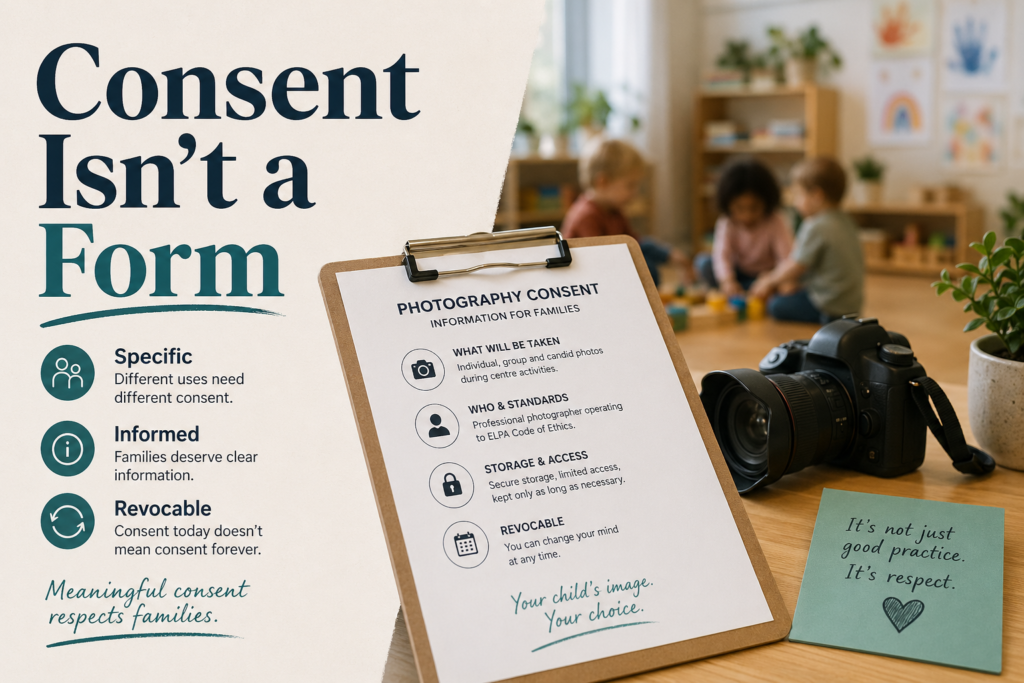
Consent, done properly, should be specific. A parent consenting to their child’s image being used in the centre’s newsletter is not the same parent consenting to individual portraits taken by an external photographer and delivered through an online gallery. Those are different activities with different implications, and lumping them into a single tick box flattens a distinction that matters.
Consent should also be informed. The parent should know what types of photos will be taken (individual, group, candid). They should know who the photographer is and what standard they operate under. They should know how the images will be stored, who will have access, how long they’ll be kept, and what happens when they’re deleted. Most parents have never been given this information. Most centres have never thought to provide it, because, again, nobody was asking.
And consent should be revocable. A parent who ticked the box in February should be able to untick it in July. Their child’s participation in photo day shouldn’t be locked in by a decision made months ago, under different circumstances, with different information. Revocability isn’t a hassle; it’s a right. And managing it practically is part of what professionals should be equipped to do.
For photographers, this means something specific. It means understanding the consent framework that applies to your session, not just assuming the centre has it covered. It means knowing which children are opted in and which aren’t before you start shooting. It means having a process for managing non-consented children during a session (because they’ll still be in the room, and they’ll still wander into the background of group shots). And it means being part of the consent conversation rather than treating it as someone else’s problem.
ELPA’s framework requires photographers to support centres in obtaining meaningful consent, not just to rely on whatever tick box the centre already has. That might mean providing a photography-specific consent form that centres can use. It might mean having a clear information sheet that goes home to families before photo day. It might just mean asking the director, “How do you handle consent for external photography, and is there anything I can do to make that easier?”
The conversation itself is the point. Consent isn’t a document. It’s an ongoing understanding between a family, a centre, and a photographer about what’s being done with their child’s image and why. The form is just where you write it down.
Learn more about ELPA’s consent framework at https://elpa.au/