
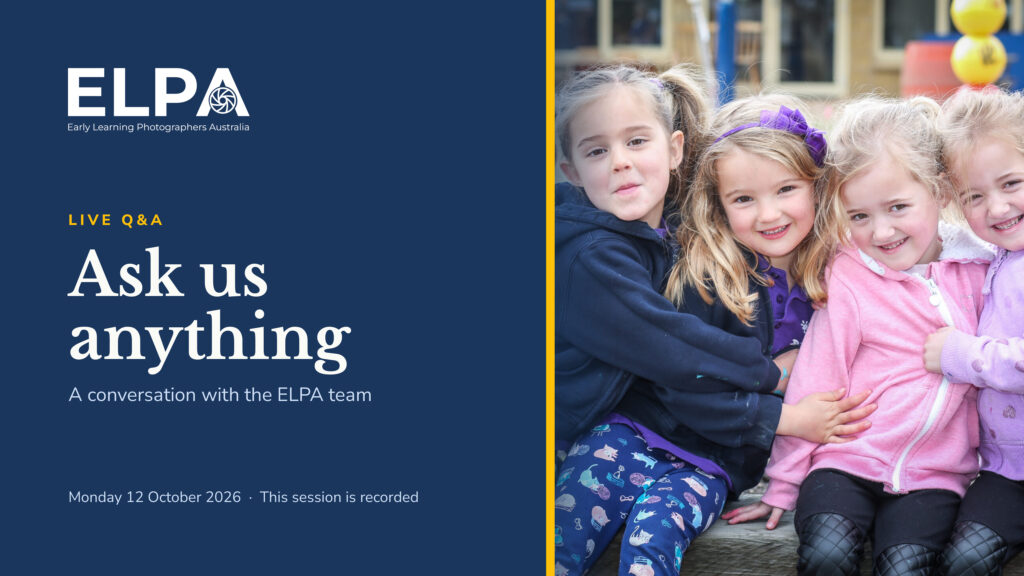
On Monday 12 October we held ELPA’s first Live Q&A, and we want to start with a simple thank you. To everyone who joined, asked a question, typed in the chat or just listened in from a centre car park between jobs: thank you for giving us the hour. It was the first time many of us have been in the same (virtual) room, and it showed that childcare photographers have a lot to say when someone finally asks.
If you couldn’t make it, the full recording is below. Here’s a quick summary of what we covered.
Why ELPA exists now
Two things have changed around us. The Early Childhood Legislation Amendment (Child Safety) Act 2025 tripled the maximum penalties under the National Law from 1 January 2026 and gave regulators more powers. Centres are being asked much harder questions about who they let through the door, and that includes us.
Then there’s the National Model Code for Taking Images or Videos of Children, published by ACECQA in 2024. It’s guidance, written for centres and their own staff, and it says very little that’s clear about outside photographers. So centres, under real pressure to keep children safe, often fill the gap with rules of their own. Some help. Many just make photo day harder without making a single child safer.
Our view is simple: if childcare photographers agree on one standard that meets the Code, centres have something to point to, and far less reason to invent their own.
What members can use today
- The Child Safe Photography Standards Framework, the written standard a centre can read and hold us to.
- The National Parent Consent Template, one consent form written specifically for photo day.
- The Photography Risk Assessment Template, the document more and more centres ask for before you arrive.
- The Position Statement on Physical Contact, which sets out in writing where the line is when you’re helping a child during a session.
- Find a Photographer, the public directory on elpa.au, filtered by state, so a centre looking for a vetted photographer finds a member.
Membership means something because we check
Every application is reviewed by a person. We sight your Working with Children Check and your current public liability certificate, you sign a statutory declaration, and we now test a demonstration gallery ourselves to confirm children’s images aren’t sitting on the open internet.
That review has turned out to help applicants as much as it protects centres. We’ve found galleries where children’s photos could be opened straight from a link with no password, and an applicant who ticked “password-protected delivery” but had no delivery system at all. Nobody in that position is approved straight away. They go into Working Towards: they’ve applied, we tell them exactly what we found, and we help them fix it before they’re approved. It isn’t pay a fee and get a badge.
Who we’ve been talking to
We’ve been in conversation with the Australian Childcare Alliance, both ACA National and ACA Queensland, the peak body that speaks for long day care operators to government. We’ve also been talking with several major childcare providers, the multi-centre operators whose child-safety and procurement policies decide which photographers get through the door. The aim is that when a provider or a peak body asks what good looks like for photography in early learning, the answer is ELPA’s standard.
Your questions
Most of the hour was handed over to you, and the recording covers every question in full. Some we couldn’t answer on the spot. We’ll answer those in writing, and you can keep sending new ones to info@elpa.au.
Become a Foundation Member
Foundation members help shape the standards from day one, and foundation membership won’t stay open forever. The application asks for your Working with Children Check, your insurance certificate, a statutory declaration and a demonstration gallery link, and a real person reviews it.
Thanks again to everyone who came. By photographers, for photographers, for the future of our industry.